Mark Rothko's restored Grey, Orange on Maroon, No. 8 is on display again
In April 2025, Mark Rothko's famous painting Grey, Orange on Maroon, No. 8 was damaged in the lower part of the huge canvas. The restoration, in collaboration with experts and Christopher Rothko, the artist's son, gave the museum new insights into Rothko's working method and pigments used. Visitors could follow the process in the Depot's restoration studio. After the completed restoration, the artwork will remain there for public viewing until it travels to Fondazione Palazzo Strozzi in Venice in March for a major retrospective.
For months, conservator Dr Rika Pause, together with the Dutch Cultural Heritage Agency, worked on extensive research into the Mark Rothko painting, one of only two Rothko paintings in Dutch art collections.
It looked at the pigments used and the way Rothko constructed his work. Using various examination methods that did not touch the paint surface and a tiny piece of paint, as small as a grain of sugar, the composition of the paint was accurately mapped. Under the microscope, it revealed how the painter built up layers of paint, while chemical analysis techniques showed which pigments his paint consisted of. Three pigments that best matched the original colours were eventually chosen for the restoration: cadmium red, ultramarine and umber.
Pause: "Rothko made his paints himself, using hare glue and various pigments. Research shows that for Grey, Orange on Maroon, No. 8, he used very little binder. This creates a powdery, matt paint layer that can be wiped away at even the slightest touch. Because he worked without a traditional primer, the paint lies directly on the canvas and the surface is extra vulnerable. For the restoration, I therefore had to develop a special paint that maintains the same matt appearance and is completely reversible. This meant I had to be extremely careful and only touch the surface with the tip of the brush."
Christopher Rothko, the artist's son, was also involved in the restoration project. He advised on the choice of specialists as well as on the presentation of the work during and after the restoration, such as the optimal lighting conditions. In addition, the museum received a unique piece of canvas from Rothko's studio. On this comparable piece of painted canvas, damages could be imitated and pigments, binders and techniques were tested first.

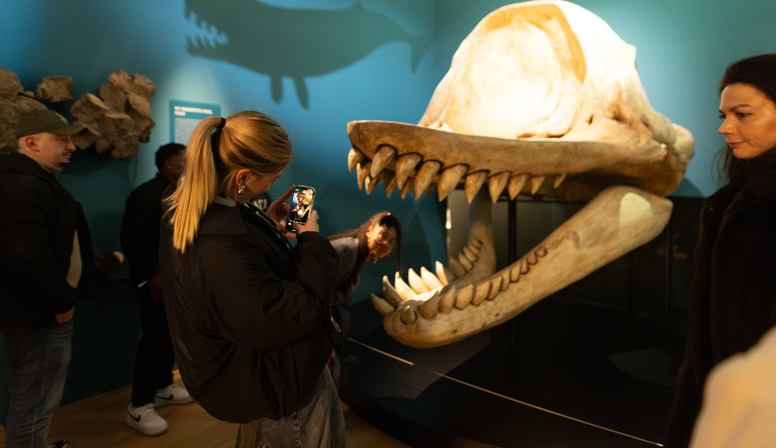
Visitor at Mark Rothko and me, Stedelijk Museum Schiedam. Photography: Aad Hoogendoor

Want to read more news?
Read more tips, background stories and news about Rotterdam.